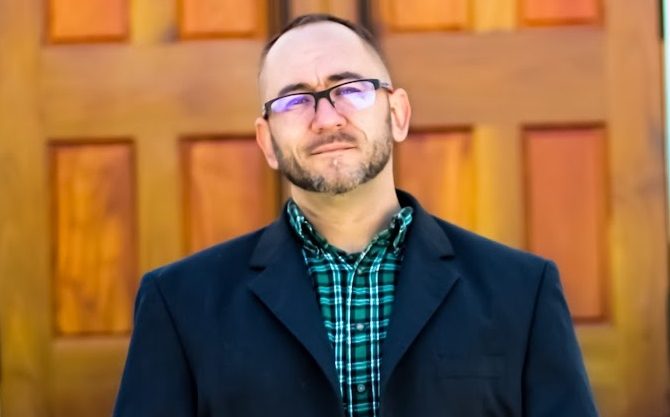
Leading With Integrity
~A commitment to transparency, service, and practical solutions for Indiana families.
Early Life
Joshua Brant was born in January 1982, and grew up in Lafayette, Indiana. His parents married when he was about two years old and then divorced about two years later. His first core memory was the violent exchange between his parents on the day his mother left his father. In the years that followed, Joshua and his younger brother would be subjected to various forms of abuse and dysfunction as the toxic divorce took its toll on the whole family. Joshua would even be called to testify to some of those abuses at a very young age. If it wasn’t for their maternal grandparents, Roy & Norma Ferry, Joshua wouldn’t have had any positive influences in those early years. Joshua’s relationship with Norma was especially close.
When the parents remarried, the abuse settled down some, but the dysfunction just doubled. On one side, Joshua and his brother gained 3 new siblings and a stepmom. They were total strangers, but somehow more entitled to their dad and the only home the boys had ever known. On the other side, they gained 3 more siblings and a stepdad. The family of seven crammed into a house that was too small. The 4 boys even had to share one bedroom at first, until the family converted the back half of the garage into another bedroom. It was also about this time that Joshua was diagnosed with ADHD.
After beating him into conforming to society’s standards didn’t work, Joshua was evaluated and found to actually be quite gifted, but simply prone to distraction and struggling with impulse control. Once medicated, he went straight to the honor roll. He would go on to develop a complicated relationship with ADHD and the medications that were prescribed to him, though. IEPs were not yet a thing, and the disorder wasn’t even widely accepted amongst educators yet. He resolved not to let his condition define him or become an excuse, but that’s easier said than done when your home is filled with conflict. Joshua’s relationship with his mom’s parents and brother, Jim Ferry, were instrumental in getting him through these early years.
By the time he reached high school, Joshua was so burned out, depressed, and disillusioned by the public school system that he was barely going through the motions. It was so bad that one of his teachers even suggested he drop out and get his GED. It wasn’t until the attack on 9/11 and his commitment to join the Marine Corps that his life began to take direction again.
Marine Corps
After the attack on the Twin Towers on September 11th, Joshua attempted to enlist in the Marine Corps Infantry, but the recruiter wouldn’t hear of it after seeing his ASVAB scores. He was given free rein to choose from any 3 jobs in the Marine Corps, and then he was shuffled into Aviation due to youthful naivety and a little recruit trickery (IYKYK). Nevertheless, Joshua set out to serve however his country needed him, but ADHD was a disqualifying condition. The only way he could serve was to hide this fact, which meant he would face one of the toughest challenges a person could go through without access to medications that put him on an even playing field for an extended period of time. He left for bootcamp in January of 2002.
After finishing basic training in MCRD San Diego & Camp Pendleton in California, Joshua studied electrical theory, troubleshooting, and aviation systems in NAS Pensacola, Florida. He then went on to specialize in communication systems at MCAS Cherry Point in North Carolina. After his schooling, Joshua was stationed with the 1st MAW in MCBH Kaneohe Bay, Hawaii. During his time in service, Joshua served as a special security augmentation to MCAS Yuma, Arizona, he served aboard the USS Bonhomme Richard (LHD-6) during the Wasp-class amphibious assault ship’s participation in the biennial Rim of the Pacific Exercise (RIMPAC), and he deployed to both MCAS Iwakuni and MCAS Futenma in Japan. He was awarded the Marine Corps Good Conduct Medal, the Sea Service Deployment Ribbon, the Global War on Terrorism Service Medal, the National Defense Service Medal, and the Navy Unit Commendation.
Due to a combination of circumstances, Joshua didn’t end up deploying to the Middle East as he originally intended, but while he was serving his country, the grandmother that helped raise him and shape him into a decent human being was diagnosed with cancer and died a few years later. For Joshua, his great sacrifice will always be those last few years with one of the most important and beloved people in his life. Between that and the continued toll of forcing himself to conform to such a rigid lifestyle without the aid of medication, he decided to leave active-duty service. After attaining the rank of Corporal, Joshua separated from the Marine Corps with an Honorable Discharge after 5 years.
College
After leaving the service, Joshua returned home to Lafayette and began studying business at Ivy Tech Community College during the day while working odd jobs at night. An unexpected segue from private security into manufacturing led to him taking part in a manufacturing management summer internship program through a factory in nearby Frankfort, Indiana. He then went on to work at Subaru of Indiana Automotive, where he continued his education. Building on his leadership training from the service, some civilian supervisory experience, and what he’d picked up from the internship, Joshua began to incorporate more elements of leadership into his studies, and even some engineering. He received an Organizational Leadership Certificate from Purdue in 2022, and his Associate of Science in Business Management in 2023.
Family Life
Joshua met his wife, Kayla, in 2013 at Barnes & Noble by the Mall in Lafayette. They had coffee together and bonded over nerdy things in the aisles between books and stories of days gone by. They had maybe two dates before Joshua’s summer shutdown from the Subaru plant, and somehow, they went from spending every day of that shutdown together to just moving in together in about two weeks. Kayla blames the cats. He made her watch Walking Dead. She made him watch Once Upon a Time. They enjoyed going to Comic-Con and theater performances together.


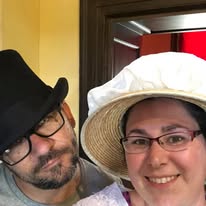
In fact, they were together for nearly 3 years when Joshua proposed during the intermission of a theater date at Beef & Boards show in Indianapolis. They had a quiet elopement at the Aberdeen Inn in Valparaiso in November 2016. For their honeymoon, they went to Scottland, Ireland, and England. What do you think? Did they pull off the British look?
You better believe it.

In December of 2019, Kayla gave birth to their son James; named after his uncle. James is such a special little boy. He’s got his Great Grandma Ferry’s eyes and his father’s orneriness. His dad would say he’s got his mother’s mischievous side too, for double the trouble.
It’s true what they say, though…


They grow up too fast.
Blink and you miss it.


And just when you think you got it all figured out…
Life throws you a little curveball.


The Brant family is currently in the process of adopting Joshua’s niece, which is why her face has to be blurred out for the time being, unfortunately. The family is coming together nicely, though, and they are ready to see where this next chapter takes them.
Faith
Joshua’s faith is rooted in a Southern Baptist upbringing, but disagreements with the church pushed the family away from brick & mortar worship pretty early on. By the time his parents remarried, Joshua began to question his faith altogether. At that age, he just couldn’t understand how a good and just God would subject him & his brother to so much suffering.
For a time, he rejected religion altogether and even declared himself an atheist, but when he was introduced to the concept of agnosticism, he realized that his faith was still alive & well. He just wasn’t sure what that looked like anymore. He didn’t realize it at the time, but this would trigger a life-long journey of philosophizing and faith exploration.
Joshua began to read about other religions and tried a few on for size. His Uncle Jim introduced him to Buddhism, which Joshua actually adopted as his personal ideology for several years. His faith became important enough to him that he even went so far as to become ordained online, which to some might seem gratuitous, but for Joshua it was a solemn vow to be a man of faith and continue his spiritual journey. As he went out into the world and was introduced to other cultures and ways of thinking, he eventually came to the conclusion that all religions share a common thread. He adopted the belief that all religions essentially believed in the same God but just referred to them by different names.
As Joshua learned more about world religions over the years, and how people throughout history have mistranslated or even manipulated religious texts for their own purposes, Joshua moved away from the idea that faith is something that can be defined by a book. He distanced himself from the presumption that organized religion even had any real clue as to what the mysteries of the universe held. He came to the conclusion that faith is intuitive and personal rather than systematic and objective, and he began to look inwards to the voice that spoke to him without words whenever he prayed or meditated.
After 40 years of reflection, research, prayer, and meditation, Joshua has determined one universal truth that cannot be denied: The root of all evil and sin in this world is selfishness. Every single prophet, savior, wise-man, and saint across every religion, and throughout human history, has always preached the same message of selflessness, and somehow people always manage to miss that fact (or ignore it entirely). In Christianity, we are taught that nobody is without sin, which is true, because we are all born inherently selfish. Anybody who has raised children of their own can attest to this, but that it is our role as parents to teach our children to be less selfish. As such, Joshua has committed to a life of unselfing, a concept introduced by Irish-British philosopher, Iris Murdoch, as turning one’s attention away from our self and focusing instead on the people & world around us. It is a detachment from one’s own id, the part of us that drives basic instincts and self-serving desires.
Joshua has found a great deal of inner peace through this philosophy of unselfing. Though he had already entertained the idea of running for office, Joshua credits the lifestyle change as the deciding factor for actually taking concrete steps towards running. He recognizes that the road ahead will be filled with criticisms, insults, attacks on his character, and possibly worse, but he believes wholeheartedly that a little bit of selflessness is just what this country needs.
Politics
It was our nation’s invasion of Iraq that inspired Joshua to start taking more of an interest in the actions of our government. They announced we would be going to Iraq while he was in bootcamp, and it almost seemed like a bait & switch scam to him. He had joined the service to defend America after the attacks on 9/11, but Iraq didn’t seem to have anything to do with that. Of course, now we know that we were sold on a lie to fight another nation’s war for them.
After his separation from the service, Joshua started becoming more and more active in politics. He was sold on the promises of Hope delivered by Barack Obama and celebrated his win as the first African American to hold the office. He knew at the time, though, that if Obama didn’t deliver on that promise that things would get ugly. He didn’t expect the ugliness to start before the newly elected President even did anything, though.
Joshua would not go on to vote for Obama a second time, but he watched with disappointment as friends, family, and co-workers rejected the President without even giving the guy a chance. The personal attacks, hyperbole, and outright lies that were spread about Obama seemed so petty and unwarranted. Some people Joshua recalled talking to couldn’t even give specifics on what they didn’t like about Obama; just that they didn’t like the President or his policies. It didn’t take him long to realize that the media had a lot to do with this.
Joshua watched as the media pitted people against their President with rhetoric and misinformation. He saw Glenn Beck, in particular, stir people’s discontent into a movement that began to infiltrate the Republican Party and displace establishment Republicans. His book, “How to Argue with Idiots,” became a strategy guide for their eventual takeover. The Tea Party, as they called themselves (at Beck’s suggestion), became a force to be reckoned with, and the Republican Party was happy to have a passionate movement to bring in more votes. In seeing this, Joshua felt justified in his decision to side with the Democrats.
Then, Obama announced the Affordable Care Act, which became the focus of much heated debate. The President held a healthcare summit as a show of good faith, but his own Vice President left him to fend for himself against the opposition right from the beginning and he casually dismissed legitimate concerns from the Republicans. In addition to disregarding the right, Obama repeatedly spoke to the needs of insurance companies when explaining his reasonings for many aspects of his plan, as if catering to those that were part of the problem was going to help solve the problem. The summit ended with the President challenging Republicans to come up with something better, but then he signed Obamacare into law just a few weeks later.
Joshua came to realize that this was more about timing and rushing the bill through, while Democrats held the power to force it through, than it was about ensuring Americans received a quality healthcare reform package. He began to see that this was part of a pattern of shared behavior between the two parties, even though they would criticize each other for it publicly. This left a bad taste in his mouth for both major parties and he began supporting third parties as a result.
As the years went on, and the political atmosphere in the United States continued to become more toxic, Joshua brought his analytical and philosophical nature into the fold. He learned that the United States was not founded on a two-party system in the way that we see it today. In the beginning, if Americans weren’t satisfied with the two major parties, a third party would rise up and take the place of the weaker party. The Democratic Party did exist from very early on, but it changed forms multiple times throughout US history. It wasn’t until the Republican Party formed in 1854 that we truly became a strict two-party nation, and those parties would go on to create barriers against third parties ever rising up in the future. The idea that voting for a third party was throwing your vote away didn’t emerge until the late 20th century and quickly became a self-fulfilling prophecy.
Joshua wanted to understand the root of our country’s division, and so he began to look at what really defines and differentiates between the two parties. He learned that, initially, there were just a lot of differences of opinion on how the new country should be formed, but that the Founding Fathers did their best to mitigate those differences. The Senate, for example, was an attempt to balance the power between big states and small states. The electoral college was intended to address the disparity between city and rural living. At the heart of modern politics, though, we have conservative ideals vs liberal ideals, with each of our major parties claiming to champion one or the other.
After a little research, Joshua came to realize that nearly every country in the world has some form of conservatism vs some form of liberalism, but that the center point between the two varied from country to country. So, he sought to understand the difference between these root ideologies. What was the common thread that divided, not just America, but seemingly people throughout the world? What he found, when he sifted through all the issues, the opposing positions on each of those issues, and the reasonings behind those positions, was that the common denominator was change. At our core, as human beings, we are simply divided by our approach to change. Liberals push for change because they know that the world cannot improve and evolve without change. Conservatives tend to resist change because they understand that not all change is positive or constructive. In essence, they were two sides of the same coin. Liberalism was the driving force behind making countries better. Conservatism was the stabilizing force that vetted change and kept it from occurring too rapidly. Then, Donald Trump came along and challenged all the norms.
Trump came into the political limelight as part of the growing anti-Obama sentiment and quickly became the de facto leader of the Tea Party movement, which was rebranded as the MAGA movement after Trump’s campaign slogan, “Make America Great Again.” He catered to the anti-Obama sentiment, gave them hats, and promised them a greatness that only ever existed for a select few, and in return they made him President. His election, much like his campaign, was filled with controversy and sparked protests nation-wide. His policies were focused on undoing everything his predecessor had done, building a wall along the southern border, and pulling support from international allies, but his term was arguably overshadowed by the COVID-19 pandemic, his complete denial of losing his bid for re-election, and the resulting events on January 6th.
Despite Trump’s best efforts, the election results were certified by a Hoosier with integrity: Mike Pence. Though Joshua disagreed with some of Pence’s policies over the years, he respected the man for doing the right thing under pressure. In that moment, Mike Pence was a shining example of what it means to be a Hoosier, and why Indiana produces some of finest leaders in America. As Hoosiers, we may differ on a lot of things, but for the most part, we handle our business, we walk our own path, and we don’t let anyone push us around.
Joe Biden would go on to oversee much of the economic recovery after the pandemic. As Trump had done before him, Biden also spent much of his term undoing his predecessor’s actions, marking another escalation in the oppositional relationship between the parties. Biden’s legacy would then go on to be tarnished by his mishandling of immigration, foreign affairs, and what appeared to be internal sabotage of his bid for reelection by his own party. The Democratic Party chose his Vice President, Kamala Harris, to run in his stead. She would then go on to impress nobody and lose the Presidency back to Donald Trump.
Trump, who made sure to stay the topic of conversation throughout Biden’s presidency, enlisted the help of some powerful allies to win a second term. Most notably, Elon Musk, whose subsequent over-involvement in US affairs and notable increase in government contracts afterwards are pretty clear indicators of corruption, whether one agrees with his actions or not. Several other major donors to Trump’s campaign have also been placed into some of the highest positions of power in the country. Regardless of whether one agrees with his appointments, this too is a pretty clear indication of corruption. Appointing and replacing many more government officials on the basis of loyalty rather than qualifications is also particularly concerning, especially considering the events that unfolded at the end of his first term, his repeated willingness to misuse our military, and his new habit of acting first & worrying about the consequences later.
Were that not enough, he tried to bully and extort our great state into bending to his will, despite knowing Hoosiers did not support redistricting. The backbones shown by those in the Indiana General Assembly that actually stood up to Trump are another perfect example of how the best Hoosiers handle our business, walk our own path, and don’t let anyone push us around. These people should be commended for their integrity. Instead, the sanctity of their homes was violated, and their own party (or rather Trump) is sending primary challengers to punish them for doing the right thing.
Joshua Brant believes the goal of running for office should never be to punish someone, but to enrich the lives of all those we are elected to represent.
Regardless of whether we agree with Trump’s policies or not, though, we simply cannot ignore his methods any longer. They will simply be abused by others in the future if permitted to stand. The precedents he is setting are bad for America, they are continuing to escalate the oppositional relationship between the parties, and they are not “America First” as he had promised. Not only has he not ended any foreign entanglements; he’s involved us in more.
The time has come to take a good long look at our situation and ask ourselves just what the Hell are we doing? If things continue down the road they are going, there is a very real possibility that there could be another civil war, and I don’t believe that is hyperbole. For those that might invite that scenario, I beg you to heed the words of Abraham Lincoln, who famously said, “A house divided against itself cannot stand.” Should we find ourselves in a civil war right now, with geopolitics being what it is, we would almost certainly be invaded by our enemies in the world, of which we’ve made plenty. And though our military forces are unrivalled in the world, they would likely be divided, even amongst themselves; spread out throughout the world, fighting other peoples’ fights; and potentially being asked to fire on their fellow Americans.
Joshua Brant would like to avoid such a scenario.
Joshua believes that the time has come to take a stand; not against one party or the other, but against government corruption in all its forms. He believes that the only way a candidate can be serious about rooting out corruption is to run as an independent and not be at the behest of the corruption in either party. He knows that this will be a more difficult path, but doing the right thing isn’t always easy.
The political climate is becoming increasingly volatile, but Joshua’s chaotic upbringing, ADHD, and being split between two worlds for much of his life make him particularly adapt to navigating the turmoil ahead. His time in the service taught him to lead with Honor, Courage, and Commitment, and his continued commitment to leadership over the years has taught him that true leadership is a service to The People. That’s why he needs all of our support.
This isn’t about one party over another, and Joshua isn’t asking anybody to compromise their values. This is about recognizing that things are spiraling out of control. This is about a man answering a call to service for his country, as he did after 9/11, and making sure the last few years he lost with his grandmother during that time weren’t in vain. This is about handling our business, walking our own path, and not letting anyone push us around.
Let Freedom Ring…
Campaign
In addition to the priorities outlined HERE, Joshua Brant vows to run on these 3 Guiding Principles:
- Reunification: Focusing on common goals and bringing Americans together.
- Maximum Transparency/Anti-Corruption: These things go hand-in-hand.
- Paving the Way for a More Prosperous & Virtuous Nation for All.
Vision for the Future
Joshua Brant envisions a future America that serves the needs of all Americans, and Americans First. He believes in an America where the needs of the many need not be weighed against the needs of the few. Most importantly, he believes in a strong and United States of America. Why stop at Great when you can do Better?
“Why settle for GREAT when you can Do Better?”
~Joshua Brant
 Brant Endeavors